
From Passive Driver to Grid Partner: Unlocking VPP Incentives in Australia
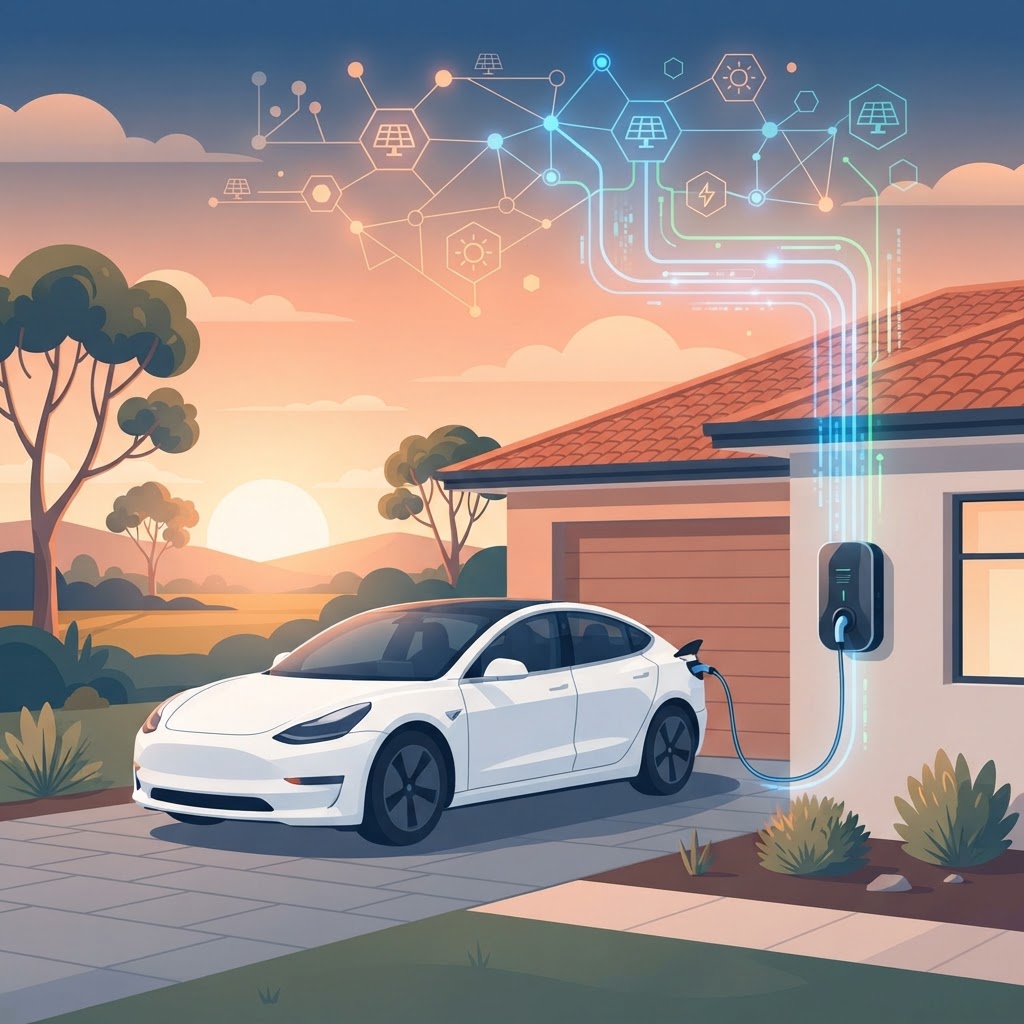
Your EV is More Than Just a Commuter
For most Australian EV drivers, the vehicle is simply a way to get from A to B. But behind the scenes, a quiet energy revolution is happening. Across the National Electricity Market (NEM), the grid is becoming increasingly complex. As more rooftop solar floods the system, we face the 'Duck Curve'—a surplus of energy during the day and a sharp demand spike at dusk. This is where your EV enters the equation.
By joining a Virtual Power Plant (VPP), you stop being a passive consumer and start becoming a grid-stabilising partner. Instead of just pulling power, your car begins to act as a decentralised battery, helping retailers like Amber, AGL, or Origin balance the load.
What Exactly is a VPP?
Think of a Virtual Power Plant as a digital layer that aggregates hundreds or thousands of home batteries and EV chargers. By using smart software, the operator can signal your charger (or your vehicle’s V2G system) to adjust how much power it draws, or even export power back to the grid during peak demand times.
Why Participate in an Australian VPP?
- Financial Rewards: Many retailers offer sign-up bonuses, annual credits, or higher feed-in rates for customers who allow their hardware to be managed.
- Grid Stability: By shifting your charging demand away from peak periods (like the 6 PM dinner rush), you help prevent the need for expensive, high-carbon 'peaker' plants.
- Automated Savings: You don't have to manually watch the AEMO wholesale prices; the VPP software does the heavy lifting, ensuring you charge when electricity is cheapest or even negative.
Getting Started: The Tech Requirements
To become an active participant in an Australian VPP, you need a few critical pieces of infrastructure. First, you need an internet-connected smart charger (OCPP-compliant) or a vehicle that supports telematics integration. Second, your current energy retailer must support VPP orchestration.
Check your Eligibility
- Hardware Compatibility: Ensure your wall-box charger is supported by the energy provider’s app (e.g., Wallbox, Zappi, or Tesla Wall Connector integration).
- Vehicle Connectivity: Some VPP programs work directly with your car's API (like Tesla or BYD models) without needing a specific smart charger.
- Electricity Plan: You will likely need to move to a 'smart' or 'wholesale' price plan. This is perfect for those with high solar export, as it allows you to charge for free when the sun is peaking or even get paid to charge when wholesale prices go negative.
The Future: V2G vs. VPP
While VPPs currently focus primarily on Smart Charging (V1G)—where your charging speed is modulated—the future lies in Vehicle-to-Grid (V2G).
With V2G, your EV isn't just turning its intake down; it’s pushing energy back into the house or the grid. In Australia, we are seeing the first wave of CCS2-compatible V2G chargers hitting the market. Once this is mainstream, your EV effectively becomes a giant home battery, potentially earning you significantly more revenue than a static Powerwall ever could.
Final Thoughts: Should You Join?
If you have a home solar setup and an EV, joining a VPP program is arguably the most efficient way to lower your 'cost-per-kilometre.' The barrier to entry is lower than ever, and with the transition away from gas and coal, your car is destined to be the most important asset in your home's energy portfolio.
Start by checking your current retailer’s website for 'EV demand response' or 'VPP' programs. Even if you aren't ready for V2G yet, simple smart charging orchestration can turn your EV from a cost centre into a profit centre.